
Uni Mail Hub — Centralized Transactional Email Infrastructure & Management Platform
- Industry
- SaaSEmail InfrastructureDeveloper Tools
- Service We Provided
- System ArchitectureBackend DevelopmentAPI DevelopmentEmail Infrastructure IntegrationAdmin Dashboard DevelopmentQueue & Worker ArchitectureDatabase DesignSecurity & Access ControlDocker DeploymentProduction Monitoring
- Scope of Work
- Product ArchitectureCentralized Mail APIManaged MailboxesProject API KeysOutgoing Mail QueueBackground WorkersSMTP DeliveryDelivery Status TrackingPostgreSQL Data LayerRedis Queue/CacheProduction DeploymentMulti-Project Integration
- Links
- Visit website
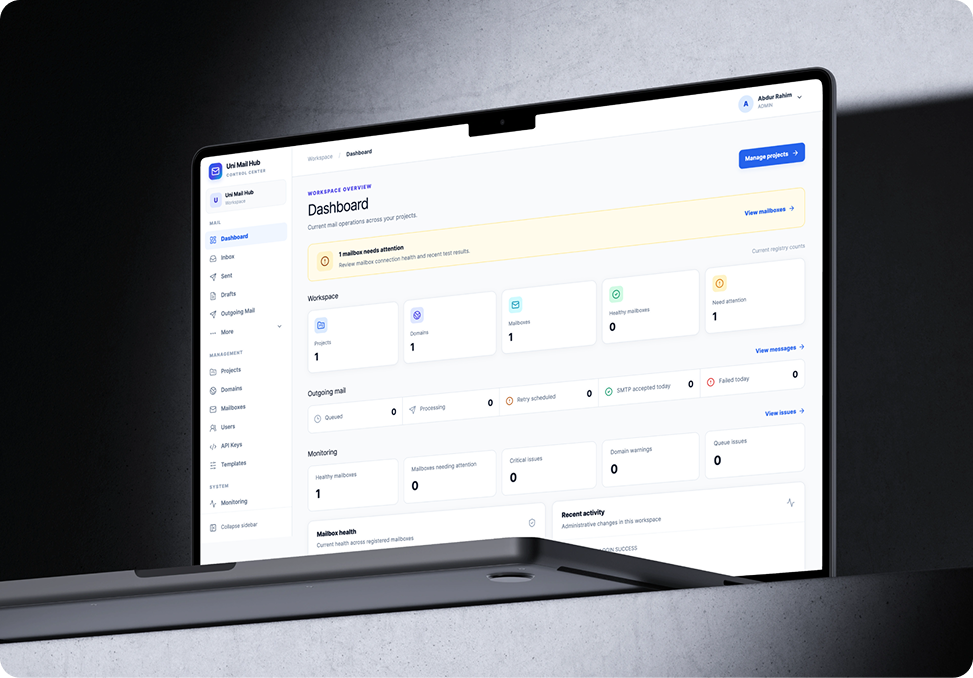
Uni Mail Hub is a centralized email infrastructure platform built to manage transactional and application-generated email across multiple Unicode IT products from one controlled system.
About the Project
Uni Mail Hub is a centralized email infrastructure platform built to manage transactional and application-generated email across multiple Unicode IT products from one controlled system.
Before Uni Mail Hub, individual applications could require their own SMTP configuration, credentials, mailbox logic, delivery handling, and debugging process. This created duplicated configuration, inconsistent behavior, and additional maintenance across projects.
We built Uni Mail Hub as a dedicated internal mail platform where applications communicate with a centralized API using project-specific credentials and managed mailbox identities. The hub handles message acceptance, queueing, background processing, SMTP delivery, status tracking, and operational visibility independently from the source application.
This allows websites, SaaS platforms, CRMs, contact forms, and other Unicode IT products to send email through one reusable and maintainable infrastructure instead of implementing mail delivery separately in every project.
Problems
Managing email independently across multiple software projects created several technical and operational problems:
- Every application required separate SMTP configuration and credential management.
- Mail-delivery logic was duplicated across different projects and technology stacks.
- SMTP credentials could become tightly coupled to application code or deployment environments.
- Troubleshooting failed or delayed messages required checking individual applications separately.
- Different applications handled retries, failures, and delivery status inconsistently.
- Changing an email provider or mailbox configuration could require updating multiple applications.
- There was no single operational view of outgoing mail across Unicode IT products.
- Production applications needed a secure way to send email without exposing SMTP credentials to the frontend.
Challenges
Architecture & Integration Challenges
- Designing one mail service that could safely support multiple independent applications
- Providing project-level API authentication while keeping SMTP credentials centralized
- Supporting different managed mailboxes without duplicating infrastructure
- Creating a simple integration contract that could be reused by WordPress, Next.js, SaaS products, CRM systems, and other applications
Delivery & Reliability Challenges
- Separating HTTP request handling from slower SMTP delivery
- Preventing mail delivery from blocking the source application
- Managing queued, processing, successful, and failed delivery states
- Handling temporary SMTP failures and operational errors predictably
- Ensuring queued messages remained trackable throughout the delivery lifecycle
Security & Operations Challenges
- Keeping private API keys and SMTP credentials server-side
- Restricting project access to authorized mailboxes and APIs
- Validating production configuration before deployment
- Maintaining reliable PostgreSQL and Redis connectivity
- Deploying API, web, worker, database, and Redis services consistently
- Making production updates without interrupting other applications using the mail service
Our Solutions
- Centralized Mail API: Built a reusable server-side API that applications can call instead of connecting directly to SMTP infrastructure.
- Project-Based Authentication: Applications authenticate using private project API keys, allowing mail access to be controlled independently for each integration.
- Managed Mailboxes: Centralized mailbox configuration so applications reference approved mailbox identities instead of storing mail-server credentials themselves.
- Queue-Based Delivery: Incoming email requests are accepted and queued for asynchronous processing, preventing SMTP delivery time from slowing down the source application.
- Background Worker Architecture: Dedicated workers process outgoing email separately from the web/API layer, improving reliability and operational isolation.
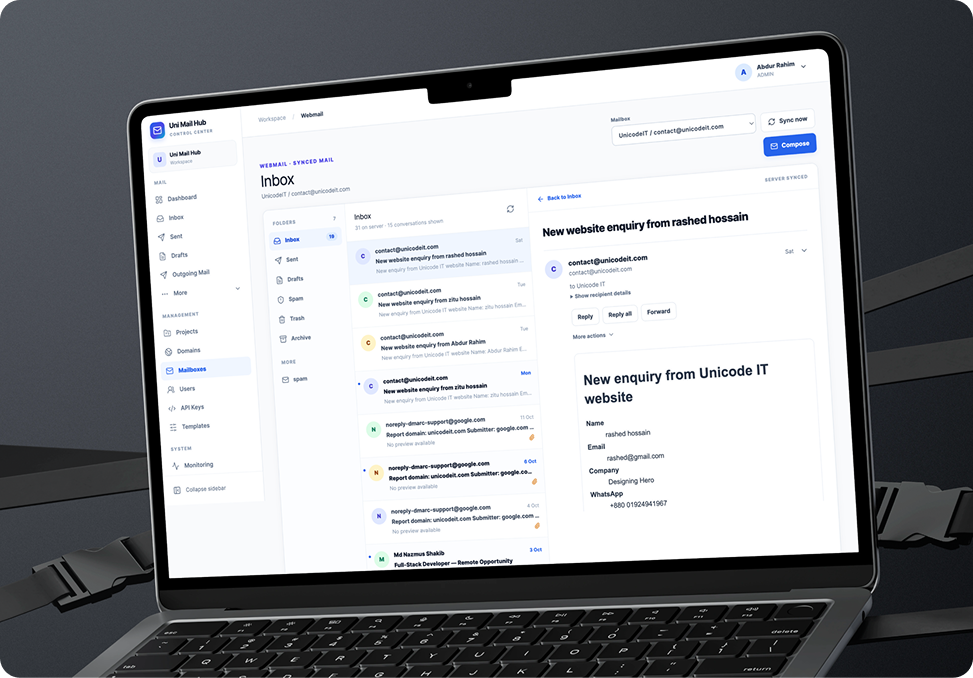
- Delivery State Tracking: Added clear delivery lifecycle states so messages can be monitored from acceptance through processing and SMTP delivery.
- PostgreSQL Persistence: Used PostgreSQL to maintain durable application, mailbox, message, configuration, and delivery-related records.
- Redis Integration: Used Redis for fast queue/runtime coordination required by background processing and asynchronous workloads.
- Secure Server-Side Integration: API credentials and mailbox identifiers remain in server-side environment variables and are never exposed to browser clients.
- Origin & Integration Controls: Production integrations can restrict where requests originate and keep application-specific configuration isolated.
- Production Validation: Added deployment checks for configuration, secrets, database connectivity, Redis connectivity, migration state, and infrastructure requirements before production changes are applied.
- Dockerized Infrastructure: Containerized the web/API, worker, PostgreSQL, and Redis services so the platform can be deployed and operated consistently on the VPS.
- Reusable Integration Model: Other Unicode IT products can integrate with the same mail infrastructure using a small set of environment variables rather than implementing a separate email system.
Technology Stack
- Node.js / JavaScript
- TypeScript
- NestJS API
- Next.js web application
- Prisma
- PostgreSQL
- Redis
- BullMQ
- Docker / Docker Compose
- SMTP email infrastructure
- REST/API-based integrations
- Background worker/queue processing
Technology & Development Approach
Uni Mail Hub was designed as infrastructure rather than a feature tied to one application.
The core architecture separates:
- application/API requests
- persistent data
- asynchronous mail processing
- SMTP delivery
- operational management
Applications integrate using configuration similar to:
- Mail Hub URL
- private project API key
- managed mailbox ID
This architecture keeps email credentials and delivery logic inside Uni Mail Hub while client applications only need to submit validated mail requests.
The system uses PostgreSQL for durable data, Redis for asynchronous processing/runtime coordination, dedicated background workers for mail delivery, and Docker Compose for production deployment.
This makes the service easier to maintain, monitor, secure, and reuse as the number of Unicode IT applications grows.
The Final Result
Uni Mail Hub now provides Unicode IT with a centralized and reusable email infrastructure for its software products.
The completed system provides:
- One mail-delivery platform shared across multiple applications
- Project-specific API authentication
- Centrally managed mailboxes
- Server-side protection of mail credentials
- Asynchronous queue-based email processing
- Dedicated background workers
- Persistent delivery records and status tracking
- PostgreSQL-backed data management
- Redis-powered processing infrastructure
- Dockerized production deployment
- Consistent integration across websites, SaaS platforms, CRM systems, and internal applications
Applications such as the Unicode IT website can now submit contact-form email through Uni Mail Hub using an API key and mailbox ID while the hub handles the actual delivery lifecycle independently.
The result is less duplicated mail code, simpler application configuration, improved operational visibility, and a scalable foundation for centralized transactional email across Unicode IT products.