
UniCRM — SaaS CRM, Lead Management & Business Automation Platform
- Industry
- SaaSCRMSales AutomationBusiness Operations
- Service Category
- SaaS Product DevelopmentFull-Stack Web Application DevelopmentCRM DevelopmentBusiness Automation
- Service We Provided
- Product ArchitectureSaaS DevelopmentBackend DevelopmentAPI DevelopmentCRM Workflow DevelopmentLead ManagementCustomer ManagementPipeline DevelopmentAutomation DevelopmentWeb-to-Lead IntegrationDashboard DevelopmentBackground Worker ArchitectureDatabase DesignObject StorageSecurity & Access ControlProduction Deployment
- Scope of Work
- CRM ArchitectureLead CaptureContact ManagementCustomer ManagementSales PipelineLead LifecycleActivity TrackingFollow-Up ManagementWeb-to-Lead APIBusiness AutomationWorkflow AutomationBackground JobsSecure Inbound IntegrationsPostgreSQL Data LayerRedis Runtime/Queue LayerMinIO Object StorageDocker DeploymentProduction OperationsExternal Product Integrations
- Links
- Visit website
UniCRM is a SaaS customer relationship management and business automation platform built to help companies manage leads, customers, sales activity, follow-ups, and operational workflows from one centralized system.
About the Project
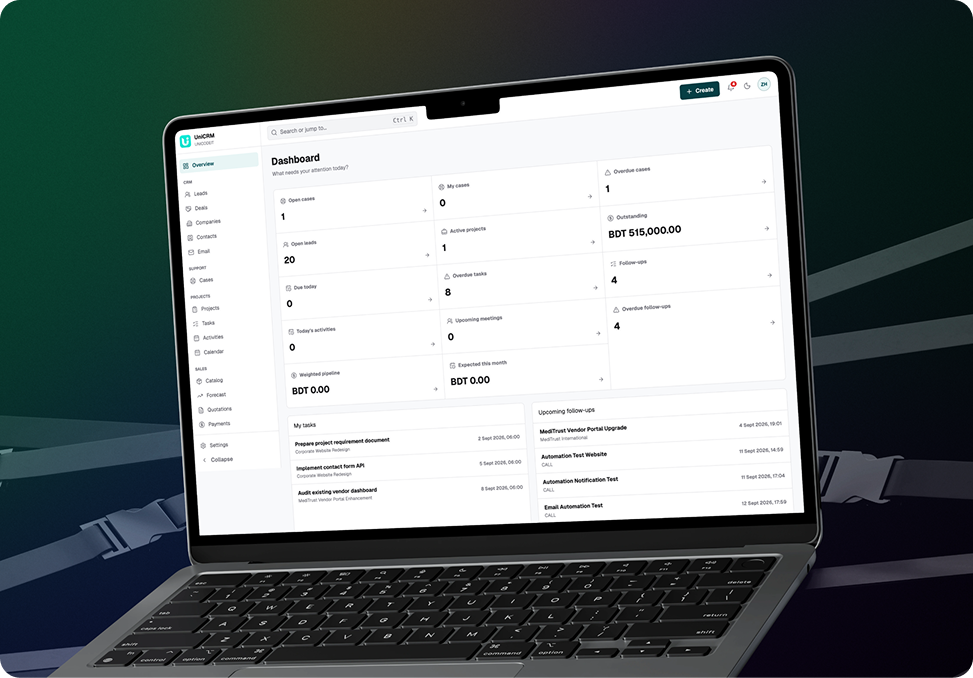
UniCRM is a SaaS customer relationship management and business automation platform built to help companies manage leads, customers, sales activity, follow-ups, and operational workflows from one centralized system.
The product was designed for businesses across different industries rather than for one specific organization. Teams can use UniCRM to capture incoming opportunities, organize customer information, manage sales pipelines, track activities, automate repetitive CRM tasks, and connect external websites or applications through secure integrations.
A major goal was to make the CRM flexible enough to support different lead sources and business processes while keeping the user experience structured and manageable.
UniCRM also provides a secure Web-to-Lead integration model. External websites and applications can submit qualified lead information directly into the CRM through authenticated server-side requests. Unicode IT's own website is one example of this integration, but the same architecture can be reused by other businesses and applications.
The result is a standalone SaaS CRM platform that combines lead management, customer relationship workflows, integrations, and automation in one extensible system.
Problems
Many growing businesses manage leads and customer relationships using a mixture of spreadsheets, inboxes, contact forms, messaging tools, and disconnected applications.
This creates several operational problems:
- Leads from different websites and campaigns remain scattered across multiple systems.
- Sales teams lack a single source of truth for customer and opportunity information.
- Manual lead entry wastes time and increases the chance of missing or duplicating information.
- Follow-up activity can become inconsistent between team members.
- Sales pipelines are difficult to understand when status is maintained manually.
- Repetitive CRM tasks consume time that could be automated.
- Different businesses need different workflows rather than one rigid CRM process.
- External websites need a secure way to send lead information directly into the CRM.
- Integrations must keep private CRM credentials away from frontend/browser code.
- Background tasks, automation, uploaded files, and CRM data require reliable production infrastructure.
- As usage grows, the application must remain maintainable and extensible rather than becoming a collection of disconnected features.
Challenges
SaaS & Product Architecture Challenges
- Designing the CRM as a reusable SaaS product rather than a company-specific internal tool.
- Creating CRM structures that can support different industries and business workflows.
- Keeping lead, customer, activity, and pipeline information consistent across the application.
- Designing features that remain understandable as the amount of CRM data grows.
- Building the application so additional modules and integrations can be introduced later without rewriting the core system.
CRM Workflow Challenges
- Structuring the complete lead lifecycle from acquisition to follow-up and sales progression.
- Giving teams a clear view of lead status and next actions.
- Maintaining activity history and relevant context around customer records.
- Supporting different lead sources while keeping data normalized.
- Reducing repetitive manual work through automation without making workflows difficult to understand.
Automation Challenges
- Building automation into the CRM instead of treating it as a separate external tool.
- Running automation/background work independently from normal web requests.
- Ensuring automation does not block the primary application experience.
- Making automated workflows reliable and maintainable in production.
- Supporting future expansion of automation triggers/actions without tightly coupling them to individual pages.
Integration Challenges
- Building a reusable Web-to-Lead API for external websites and products.
- Authenticating inbound requests securely.
- Preventing integration secrets from being exposed to browsers.
- Keeping external applications loosely coupled to UniCRM internals.
- Preserving lead source/context when information enters the CRM.
- Designing an integration model that can be reused by different companies and websites.
Infrastructure Challenges
- Separating web, API, and background-worker responsibilities.
- Maintaining durable CRM records in PostgreSQL.
- Supporting fast runtime/background operations through Redis.
- Managing uploaded files/assets outside the relational database through MinIO.
- Deploying multiple services consistently using containers.
- Updating the SaaS platform without disrupting active integrations or background work.
Our Solutions
Centralized CRM Platform
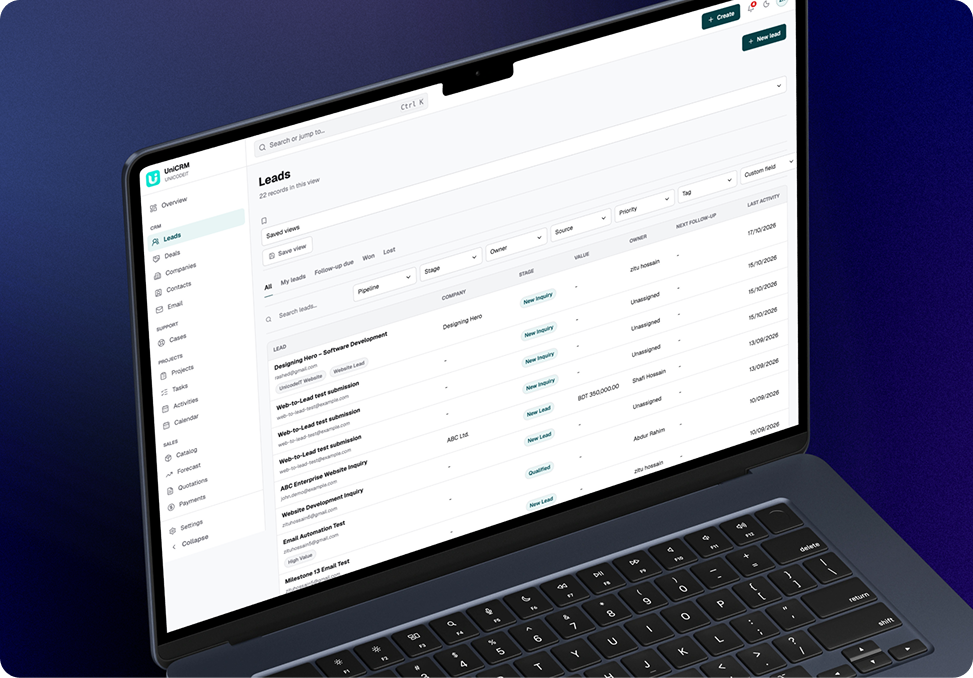
Built one system where businesses can manage leads, customers, opportunities, activities, and sales-related information instead of depending on disconnected tools.
Structured Lead Management
Created a clear lead-management workflow that keeps incoming opportunities organized and makes their status easier for teams to understand.
Sales Pipeline Management
Developed pipeline-oriented CRM workflows so businesses can track opportunities as they move through their sales process.
Customer & Contact Management
Centralized important customer and contact information so teams can maintain the context required for ongoing relationships and follow-ups.
Activity & Follow-Up Tracking
Connected activities and follow-up information to CRM records, helping teams maintain a clearer history of interactions and required actions.
CRM Automation
Added automation capabilities for repetitive CRM and business workflows.
Automation/background tasks are processed independently from normal page requests so they do not unnecessarily block user interactions.
Verified automation includes lead creation and stage-change triggers, task and follow-up creation, owner assignment, notifications, email, and webhook actions.
Secure Web-to-Lead API
Built a dedicated inbound endpoint that allows external websites and applications to create leads directly in UniCRM.
Server-Side Integration Security
External integrations use private server-side credentials rather than exposing CRM secrets in browser code.
Reusable Integration Architecture
Designed integrations so different websites/products can connect to UniCRM using a standardized API model instead of project-specific CRM code.
Background Worker Architecture
Used dedicated worker processes for automation and other tasks that should execute independently from normal web/API requests.
PostgreSQL Data Layer
Used PostgreSQL as the persistent relational data layer for CRM and business records.
Redis Runtime & Queue Infrastructure
Used Redis for fast operational coordination and asynchronous/background-processing requirements.
MinIO Object Storage
Integrated MinIO-compatible object storage for application files/assets that should remain separate from relational CRM records.
Dockerized Production Infrastructure
Deployed UniCRM as isolated web, API, worker, PostgreSQL, and Redis services, with object storage configured separately.
SaaS-Ready Architecture
Built UniCRM so the platform can continue evolving with additional CRM modules, integrations, automation workflows, and business features rather than remaining limited to a single organization's processes.
Technology Stack
- Node.js / TypeScript
- Next.js / React web application
- NestJS API and worker
- Prisma / PostgreSQL
- Redis / BullMQ
- MinIO-compatible object storage
- Docker / Docker Compose
- REST APIs and secure server-to-server integrations
Technology & Development Approach
UniCRM was developed as a standalone SaaS business platform.
Its architecture separates major responsibilities into independent layers/services:
- user-facing web application
- backend/API layer
- CRM/business logic
- automation/background worker
- relational data storage
- runtime/queue infrastructure
- object/file storage
- external integration endpoints
PostgreSQL provides durable relational storage for CRM data.
Redis supports runtime and asynchronous/background workloads.
MinIO provides object storage independently from the primary relational database.
Dedicated workers execute automation and background tasks separately from normal API requests.
External applications connect through secured REST/API integrations.
The Web-to-Lead implementation allows websites to submit lead information directly to UniCRM using a private server-side secret.
This architecture allows the CRM to remain independent from the external websites that use it while providing a standardized way for additional products and businesses to integrate in the future.
The Final Result
UniCRM has evolved into a reusable SaaS CRM and business automation platform rather than a CRM built for a single organization.
The completed system provides:
- centralized lead management
- customer and contact management
- structured sales workflows
- pipeline-based opportunity tracking
- activity and follow-up management
- CRM/business automation
- direct Web-to-Lead integration
- secure server-to-server integrations
- API-based connectivity with external applications
- background worker processing
- PostgreSQL-backed CRM data
- Redis-powered runtime/background infrastructure
- MinIO-backed object storage
- Dockerized production deployment
- an extensible foundation for additional CRM features and integrations
Businesses can use UniCRM as their central system for managing incoming opportunities and customer relationships while connecting their own websites and applications to the same CRM infrastructure.
For Unicode IT, the company's website is one real production integration: contact-form data can be delivered directly to UniCRM through the secured Web-to-Lead API. The same model can be used by other businesses adopting the SaaS platform.
The result is less repetitive manual data entry, clearer sales operations, more consistent follow-up, greater workflow automation, and a scalable technical foundation that can support businesses across multiple industries.